1,895 questions across all 8 domainsAdapts to your student's mistakesNative to the digital SAT formatWren reads handwritten workFree assessment to startA season for about one tutoring hourData stays on your device
Fall 2026 digital SAT dates
Oct 3 (register by Sep 18) · Nov 7 (register by Oct 23) · Dec 5 (register by Nov 20). Set a target date in Climb and the daily plan paces itself to whichever one your student is taking. Confirm dates and register at collegeboard.org.
The adaptive assessment, in 20 seconds · Click for sound
60-second tour · Click for sound
How it works
Set a target. Climb builds the plan.
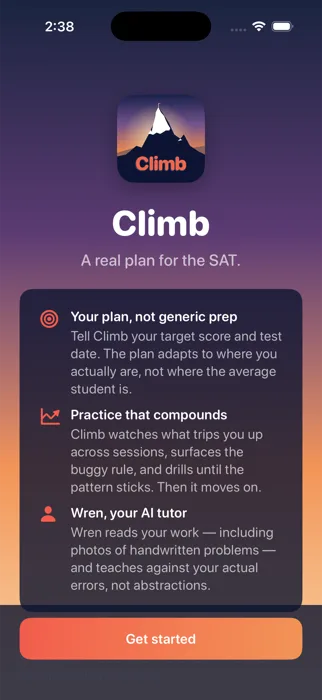
You tell Climb your target score and test date. It runs a diagnostic, commits to a plan, and adjusts the cadence to however much runway you have — real progress on 15–20 minutes a day for the typical student, more if the test is close, less if you started early. The application is structured as a sherpa-guided climb to your target on the SAT® exam — the metaphor mirrors a real Mt. Everest base-camp trek the founder is taking with his son in 2027.
1
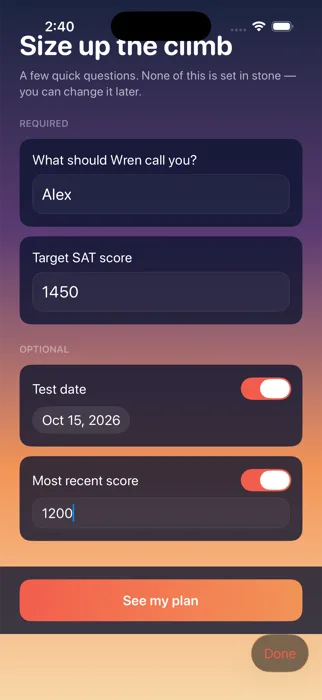
Size up the climb
What should Wren call you, your target score, your test date, your most recent score if you have one. That's it — none of it is locked in, and you can change it later.
Nothing else to fill out. Climb starts working from four numbers, not a twenty-field survey.
2
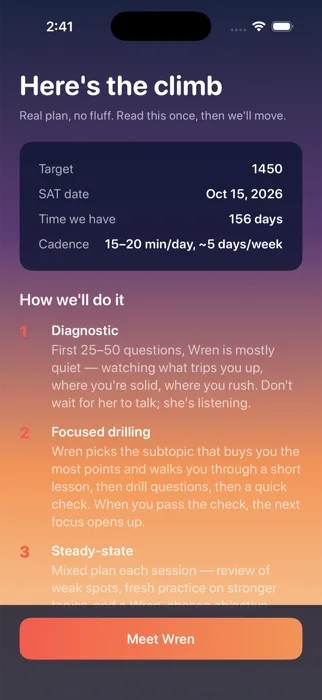
The diagnostic, then a real plan
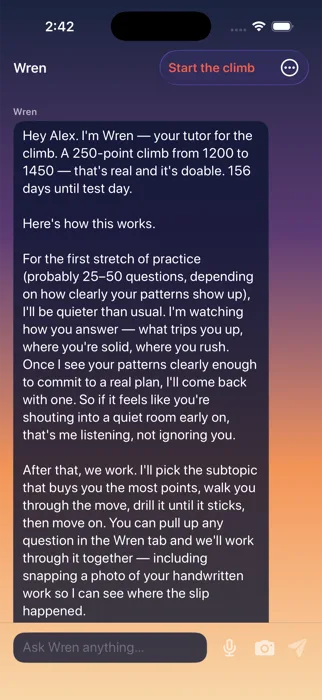
The first 30 questions are the free assessment, and they are quiet on purpose — Climb is watching what trips you up, where you're solid, where you rush, before it commits to anything. Once the pattern is clear, it names the highest-value subtopic, walks you through a short lesson, drills it, and checks that it stuck before moving on.
"First 30 questions, I'm mostly quiet — watching what trips you up, where you're solid, where you rush." — Wren, at plan start
3
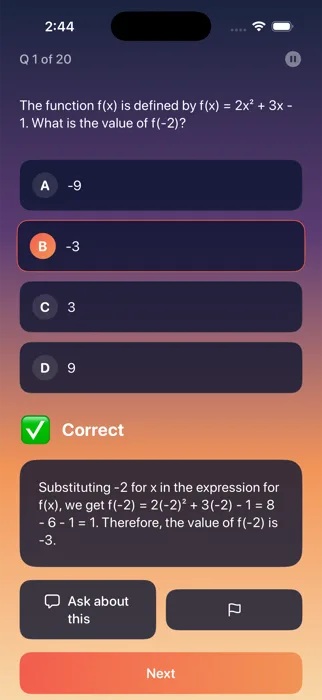
Practice that targets weak topics, not random ones
A Beta-posterior mastery model tracks what your student actually knows per subtopic. Leitner spaced repetition resurfaces cards right before they'd be forgotten. Bootstrap propagation transfers learning across difficulty tiers, so a correct answer at the Hard level also raises confidence at Medium.
A missed Easy comma-splice yesterday returns today. Nail it at the Hard difficulty and confidence at Medium rises too.
4
A daily cadence sized to your test date
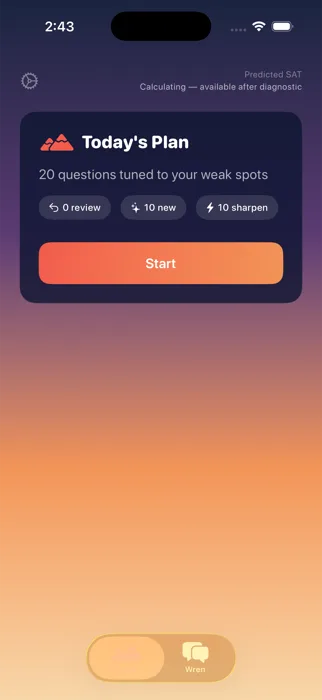
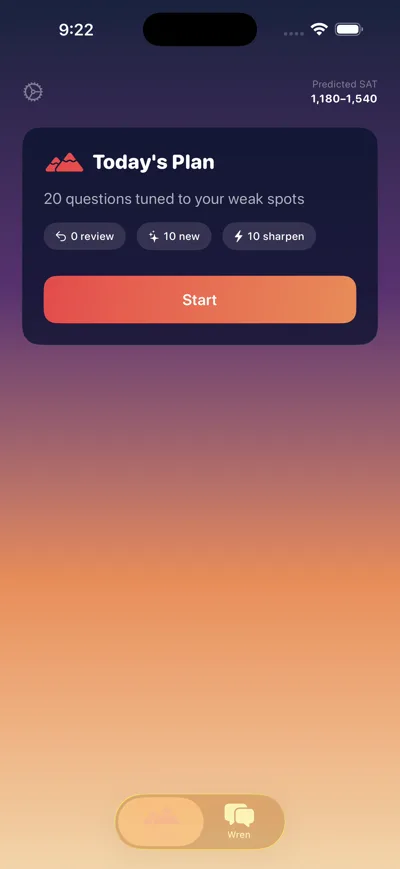
Every session opens on today's plan — a mix of review, new material, and sharpening, sized to the days left before your SAT. When the queue is empty, "0 due today" shows as a feature, not a failure. No streak, no penalty for a missed day.
Typical cadence: 15–20 minutes a day, roughly five days a week. Climb compresses that automatically as test day gets close.
5
A score projection that moves as you practice
The Coach tab shows a predicted SAT range built from your student's actual answers, not a generic curve — wide early on, narrowing as Climb collects more evidence. Today's Plan breaks the day into review, new material, and sharpening, so your student knows what they're about to do before tapping Start.
The range narrows as mastery data accumulates. It's not a one-time estimate from the diagnostic — it keeps updating.
Your AI tutor
Wren teaches against your actual mistakes
Wren isn't a chat window bolted onto a quiz bank. She reads your student's recent attempts and per-topic mastery before saying anything, anchors explanations in concrete past moments, and remembers what tripped him up weeks ago — the compounding effect that makes practice actually add up instead of resetting every session.
✦
Memory across sessions, three teaching modes
Explain (default) — names the trap and the move in three to five sentences. Diagnose — "walk me through how you got there," only when a wrong answer suggests a deeper misconception, so the student surfaces his own reasoning before the explanation lands. Reassure & Reset — after three wrong answers in a row, Wren stops teaching, acknowledges the struggle, and offers a topic he's strong in instead of piling on.
"You got the parallel-structure version yesterday. Same move here. Pick the option whose verb form matches the first item, not the one that sounds smoothest."
✦
She can read a photo of handwritten work
Most of the SAT still happens on scratch paper. Snap a photo of the work in the Wren tab and she reads it — not just the final answer, the actual steps — and points to the specific line where the error happened. That's the difference between "you got it wrong" and "this is where the sign flipped."
The photo never leaves the device beyond the request itself — Climb doesn't store or serve it back from a server. See privacy.
The climb
Real progression, real mountain
Mastery growth maps to altitude on Mt. Everest — Kathmandu at the start, Everest Base Camp once fundamentals are secure, Camps 1–4 and the summit at advanced mastery. Every answer writes a real altitude time-series. It's the same route the founder is walking with his son in 2027 as a graduation trip. No fanfare at stage transitions, no achievement sounds — the mountain is real, so the metaphor stays earned.
Altitude is earned, not unlocked
There's no level-up animation for opening the app. Altitude moves only when mastery moves — a subtopic checked off, a Leitner card retired for good. The view is honest about where a student actually stands relative to test day, not where a streak counter says they should be.
Why we don't gamify
The easiest features we never built
Climb's first user was the founder's son, a teen whose attention was trained by Fortnite, Apex, and Genshin Impact. Every product instinct said to meet him there: XP for right answers, a streak counter, a level-up chime. That layer would have taken a weekend to build, and every engagement metric would have looked better for it.
We read the research before writing the code. A 2023 meta-analysis of educational gamification found the standard points-badges-leaderboards trio does not measurably improve a student's competence. Worse, the over-justification effect (Lepper, 1973) shows that bolting extrinsic rewards onto studying can crowd out whatever real interest was forming. Streaks reward opening the app. The SAT does not score attendance.
No XP
No streaks
No daily quests
No badges
No levels
No character classes
No leaderboards
No engagement notifications
No subscription trap
No engagement-loop manipulation
We considered each of these mechanics, audited it against the research, and removed it on purpose. Each removal is documented in the research below. The rule that survived: every reward loop must be denominated in real mastery gains, not presence. If a mechanic rewards opening the application, it is wrong. If it rewards getting better, it stays. What your student feels instead of a dopamine loop is a plan that visibly shortens the distance to their target score. That turns out to be its own motivation, and it is the one that survives contact with test day.
Content
1,895 questions, native to the digital SAT
Every question runs in the same digital-first format the actual exam uses — the same module structure and on-screen tools your student will see in Bluebook, the College Board's official testing app, on test day. Coverage spans all four Math domains and all four Reading and Writing domains the digital SAT tests, plus adaptive lessons Wren generates for the exact subtopic a student needs, not a static curriculum.
Math
Algebra
Advanced Math
Problem-Solving & Data Analysis
Geometry & Trigonometry
Reading & Writing
Craft & Structure
Information & Ideas
Standard English Conventions
Expression of Ideas
Question count: 1,895 test-eligible questions across all eight official digital-SAT domains, each with a worked explanation. Every wrong answer opens a review path back through Wren: a short lesson on the specific rule, drill questions, and a check before the plan moves on.
Privacy
Your student's work stays on their device
Climb is built with on-device data sovereignty as a default, not an add-on.
📱
Study data lives on-device
Answers, mastery records, and progress are stored locally. None of it reaches our servers.
💬
Wren's chat history is local
Conversations with the AI tutor are persisted on the device, not in a cloud account tied to your student.
🖼️
Handwriting photos stay on the phone
Photos of handwritten work are used to generate Wren's reply and are not stored on our servers.
🚫
No data sale, no telemetry
We don't sell data and don't run analytics or tracking SDKs. No third parties beyond Apple (billing) and Anthropic (the AI itself).
On the server side we hold the bare minimum to run the subscription: an App Attest device identifier (Apple's proof that a request comes from a real Climb install), current subscription state, and a per-device monthly usage counter. Full privacy policy.
Pricing
Priced for a test season, not a forever app
Free to download and start. One AI-tutoring tier when you subscribe, billed by Apple. Cancel auto-renewing plans anytime in iOS Settings and keep access until the period ends.
Start free
Download free and take a 30-question adaptive assessment: per-question right/wrong feedback, up to 10 free questions to the AI tutor while you test, and a projected score range with a plan preview at the end. No account, no card, no trial clock.
Monthly
$19.99/mo
Auto-renewing
Cancel anytime. Best if you want flexibility over commitment.
Recommended
Season Pass
$59
4 months · one-time, non-renewing
Covers signup straight through your test date. Pre-pay once, no renewal to remember to cancel.
Annual
$149/yr
Auto-renewing · ~$12.42/mo equiv.
Best for multi-cycle prep — PSAT, SAT, and a retake in the same subscription.
The subscription gates Wren, the AI tutor, up to a generous monthly usage cap — typical study usage runs well under it. The adaptive practice engine, the full question bank, and lesson content work the same on every tier.
Why Climb
How it stacks up
Acely, R.test, and Bonsai roughly share Climb's price range and all layer some kind of AI on top of SAT content. Khan Academy and Khanmigo are free and excellent for content depth. Here's where Climb is actually different — not a claim that it beats every tool on every dimension.
Khan Academy and Khanmigo have a content library Climb doesn't try to match on depth — Climb doesn't replace them there. What Climb adds is a tutor built around one student's actual error pattern, priced and structured for a single test season rather than an open-ended subscription. Your student can paste a question into any general chatbot and get an answer; the gap is a tutor that already knows what tripped him up three weeks ago and picks the right teaching move for this exact moment.
Measured
Even our worst run beats every raw frontier model
We benchmarked Climb-Wren against five raw frontier AIs: Anthropic's claude-sonnet-4-5 (Climb's model), Anthropic's claude-opus-4-7 (the flagship — most expensive model on the market), OpenAI's gpt-5 (behind ChatGPT), and Google's gemini-2.5. Four independent eval runs. The numbers below report each condition's worst single run — an anti-cherry-picked floor. If a parent or competitor re-runs the benchmark, they will mathematically land at or above what we publish here. Read the full methodology →
Out of 3. Climb-Wren's worst run versus raw Opus 4.7's worst run. Opus is Anthropic's flagship and the most expensive frontier model on the market. Climb beats it by a factor of 7.5×, on a model class that costs 5× less. The same comparison versus raw GPT-5 (worst 0.53) and raw Gemini-2.5 (worst 0.53) is +2.12. Raw Opus alone is the worst of the four raw models on this dimension — the most expensive model is not the best at unaided tutoring shape.
Mode-shape · un-fakeable
2.65 / 3 worst of 4 runs
+2.12 vs raw-Sonnet (0.53) · +2.30 vs raw-Opus (0.35) · +2.12 vs raw-GPT-5 (0.53) · +2.12 vs raw-Gemini (0.53)
Pure regex over the reply text. Worked example? Numbered steps. Diagnose? Ends with a question. Acknowledge? ≤ 2 sentences, no follow-up. Reassure-reset? Opens with a pause cue. No LLM judge — no judge bias. The most defensible single number we have, and the one we lead with.
Pedagogical quality
1.86 / 3 worst of 4 runs
+0.54 vs raw-Sonnet (1.32) · +0.91 vs raw-Opus (0.95) · +0.77 vs raw-GPT-5 (1.09) · +0.86 vs raw-Gemini (1.00)
Is the teaching move appropriate to the moment? Whether the student walks away understanding something they didn't a minute ago. LLM-judged against a rubric — disclosed because judge-mediated scoring has bias risk. The 4-run floor framing absorbs judge variance.
Error localization
1.41 / 3 worst of 4 runs
+0.18 vs raw-Sonnet (1.23) · +0.27 vs raw-Opus (1.14) · +0.37 vs raw-GPT-5 (1.04) · +0.41 vs raw-Gemini (1.00)
Does the reply name the root-cause subtopic? Climb wins here despite deliberately staying quiet on acknowledge and reassure-reset turns — modes where naming the subtopic is the wrong move.
Climb-Wren on Opus — the ceiling
3.00 / 3 every run perfect
Mode-shape 3.00 / 3 across all 4 runs · Pedagogy 2.09 (worst) → 2.23 (best)
When we route Wren's scaffolding through Opus 4.7 instead of Sonnet 4.5, mode-shape is perfect on every single run. Pedagogy lifts another ~0.1 above Wren-on-Sonnet. The system is what wins — but it scales with the brain. We ship on Sonnet because the gap is small and the price is 5× lower. A premium tier remains an option.
How the measurement works
Twenty-two scenarios — seventeen of them tagged with a teaching mode (worked example, diagnose, explain, acknowledge, reassure-reset), five generic. Three student-history fixtures (forgotten-mastery, baseline-mid, distractor-trap-rusher). For each scenario, six assistants reply: Climb-Wren on Sonnet, Climb-Wren on Opus, plus raw-Sonnet, raw-Opus, raw-GPT-5, and raw-Gemini (no system prompt, no tools, no engine recommendation — just the user message). The Climb-Wren paths also get full session history, the engine's mode recommendation, and tools wired to the database.
Four scoring dimensions per reply. One is pure regex (mode-shape) and immune to judge bias. Three rely on an LLM judge against a written rubric — we disclose this. To absorb judge variance and provider non-determinism, the full eval is run four independent times and we publish the worst per-condition score across runs (4-run floor). A skeptic re-running the benchmark lands at or above these numbers.
The system around Climb-Wren is what changes — not the model underneath. Climb ships on Sonnet 4.5. Across all four raw brand baselines and all four runs, the system wins.
Reproducible: swift run ClimbEval --live against the open-source ClimbEval harness. Live API cost per full 6-condition × 22-scenario run: ~$3. Total spend for the 4-run aggregate: ~$13.
What we don't claim
n = 17 mode scenarios × 4 runs is a real sample size, but not a meta-analysis. The worst-of-4 framing is anti-cherry-picked: a skeptic running the eval lands at or above what we publish.
The control conditions are "frontier model alone," not "ChatGPT.com's actual UI." Your student can paste a question into ChatGPT and get a response. They just won't get one that knows what they got wrong three weeks ago and chose the right teaching shape for this exact moment.
Pedagogical-quality and error-localization scores rely on an LLM judge. Mode-shape (the headline) is regex-scored with no judge involvement — that's where Climb's margin is widest and most defensible.
Gemini was tested on the 2.5-Flash tier (Pro requires Tier 1 billing promotion that's still propagating). Flash already loses to Climb by +2.12; Pro is the larger model and unlikely to close the gap on shape-appropriate teaching, but we'll re-publish with Pro once it's accessible.
Climb-Wren-on-Opus is the absolute ceiling (perfect mode-shape every run), but we ship Climb on Sonnet because the marginal gain at 5× the cost doesn't justify a higher product price for the average student. We'd rather your student have Wren than a 5× markup for a ceiling effect.
Climb-Wren scored fractionally below raw-GPT-5 on prior-context recall in some runs. Disclosed; not hidden. Climb's edge isn't in name-dropping past episodes — it's in picking the right teaching shape and finding the right anchor at the right moment.
Why these design choices
The research base
Climb's design is grounded in the educational-psychology literature on what actually moves learning outcomes. Every claim below links to the underlying work.
One-on-one tutoring is the gold standard. Climb's Wren approximates it.
Bloom (1984) found that one-on-one tutoring produces a two-standard-deviation improvement over conventional classroom instruction. The mechanism is not more time — it is that the tutor models the student's mental state, identifies the specific misconception, and intervenes against that misconception directly. Wren does this through persistent memory, mastery-state queries, and diagnostic questions that ask the student to surface his reasoning before the explanation lands.
Mild confusion correlates with learning gain. The tutor's job is not to dissolve it.
Kapur's productive-failure work shows that students who struggle with a problem before receiving instruction outperform students given direct instruction first — by effect sizes equivalent to two to three years of typical schooling on transfer tasks. Wren's diagnostic mode is engineered around this finding. When she asks "walk me through how you got there," she sustains productive disequilibrium long enough for the student to construct the right concept himself, rather than resolving the confusion immediately.
Spaced retrieval beats massed cramming, by substantial margins.
Bjork's "desirable difficulties" framework, supported by decades of cognitive-science replication, shows that spaced retrieval practice produces durable learning while massed cramming produces short-term recognition that does not survive the actual test. Climb's Leitner queue is a working spaced-repetition implementation; the adaptive sampler weights against recency to enforce spacing.
Extrinsic rewards can crowd out intrinsic motivation. So we do not add them.
Lepper, Greene & Nisbett (1973) demonstrated the over-justification effect: bolting extrinsic rewards (XP, badges, points) onto an activity in which a student might develop intrinsic interest reduces that intrinsic motivation when the rewards are removed. The implication for an app preparing students for the SAT® exam is direct: if we want a student to develop genuine interest in mastering the material, layering XP and badges on top is the most counterproductive thing we can do. Self-determination theory (Deci & Ryan) names the actual drivers of sustained motivation — autonomy, competence, relatedness — none of which are points.
The standard gamification trio does not measurably improve learning competence.
A 2023 meta-analysis of educational gamification found that points, badges, and leaderboards — the most-borrowed mechanics in ed-tech — do not measurably improve felt competence. What does move competence: appropriate-difficulty challenges with visible feedback. That is precisely what Beta-posterior mastery, Leitner spacing, and Wren's anchored explanations deliver, without badges.
Push notifications reduce learning performance. So Climb does not send any.
A 2022 study found that mobile push notifications, even non-engagement-oriented ones, measurably reduce learning performance. Climb sends no push notifications. The spaced-repetition queue creates a natural daily rhythm based on memory science; we do not need to interrupt the student to drive return visits.
Read carefully. Fact-check anything. The answers below are honest, including the limitations.
Is Climb free?
Free to download, and the first thing every student gets is free: a 30-question adaptive assessment with right/wrong feedback on every answer, up to 10 free questions to Wren (the AI tutor) during the test, and a projected score range with a plan preview at the end. Ongoing practice, the full study plan, and unlimited tutoring require a subscription. There is no time-limited trial and no card required to start.
How is this different from Khan Academy, Acely, R.test, Bonsai, Magoosh, or UWorld?
Khan, Magoosh, and UWorld have excellent content libraries — Climb does not try to replace them on content depth. Acely, R.test, and Bonsai are closer peers on price and AI-tutoring positioning. What Climb adds: a tutor who remembers your student's specific struggles across sessions, reads photos of handwritten scratch work and points to the exact wrong step, and stores study data on-device by default rather than in a cloud account. Full comparison above. Khan's points-and-badges layer is one of the elements Climb deliberately does not replicate, for the reasons in the research above.
How much screen time will my student spend in this?
Exactly as much as is mastery-productive, and no more. The application does not engineer engagement. There is no streak shaming him into opening it daily, and no notification pulling him back in the evening. The Leitner queue surfaces cards on a memory-science cadence; when the queue is empty, "0 cards due today" is shown as a feature, not a failure. Typical use is fifteen to twenty minutes per session, most days of the week.
Is my student's data safe?
Yes. Study progress, answers, and chat history with the tutor are stored only on the device — none of that ever reaches our servers. AI requests, including handwriting photos, flow from the device through our Cloudflare Worker proxy to Anthropic; the proxy is a passthrough and does not log or store the content of the requests. On the server side we hold the bare minimum to run the subscription: an App Attest device identifier, current subscription state, and a per-device monthly usage counter. No telemetry. No analytics. No third parties beyond Apple (billing) and Anthropic (the AI). Full privacy policy.
What does the AI tutor actually do, in plain terms?
Three modes. Explain — when your student gets a question wrong on something he mostly knows, Wren names the trap and the move in three to five sentences. Diagnose — when the wrong answer suggests a deeper misconception, Wren offers: "If you want, walk me through how you got there — otherwise I can show you the move directly." When he opts in, his answer reveals the specific misconception, and Wren teaches against that directly. Reassure & Reset — when he has missed three questions in a row, Wren stops teaching, acknowledges the struggle, and offers to switch to a topic he is strong in, to rebuild confidence. She can also read a photo of handwritten scratch work and point to the exact step where the error happened. Mode selection is gated on numerical mastery thresholds and recent-attempt patterns, not on intuition.
What does it cost?
Starting is free (see above). For the full app, three tiers, all billed by Apple: Monthly at $19.99/month, cancel anytime. Season Pass at $59 for four months — a one-time, non-renewing charge sized to cover signup through a typical test date, and the option we'd recommend for most students. Annual at $149/year for students prepping across multiple cycles (PSAT, SAT, a retake). The adaptive practice engine, the full question bank, and lesson content are the same on every tier — the subscription gates Wren, the AI tutor, up to a generous monthly usage cap that typical study usage runs well under.
Who is this not for?
Climb works best for students with at least an 1100 floor who can mostly self-direct. If your student needs structured tutoring through fundamentals (reading comprehension, basic algebra), this is not the right tool yet — the application assumes the substrate is in place and works on closing the gap to a target score. To be direct: Climb is not a replacement for a human tutor when one is needed, and it is not a substitute for the accountability scaffolding some students need to study at all.
How early-stage is this?
Early, and live. Climb is on the App Store now; the free assessment means you can judge it on your own student before paying anything. The founder built it for one user, his own son, and is opening it up as that work proves out. Questions before you try it: email and we will answer honestly, including whether it is a fit at all.
The story
Built for one student first
The founder's son, Westley, scored 1140 on his first SAT® exam. Target: 1340. Eighteen weeks of runway.
Westley plays Fortnite, Apex, Genshin Impact, and Baldur's Gate 3 — his attention pattern is game-trained. He expects rich feedback loops and felt progress. The temptation was to graft those mechanics onto the application: XP for every correct answer, streaks for daily use, character-class progression, all of it.
The honest move was different. The research is clear that those mechanics improve return-visit metrics but do not measurably improve learning. Westley deserves a tool that actually teaches him — not one that engineers his attention to look like it is teaching him.
So Climb went the other direction. Real adaptive practice. A real AI tutor with memory. A real mountain — because the founder and Westley are walking the Everest Base Camp trek in 2027 as Westley's high-school graduation gift, and the application's progression mirrors the literal route they will walk together. The climb is real.
If it works for Westley, it can work for other students. That is the path.
About
From KyrosWorks
KyrosWorks is a one-person operation building AI-native software for the kind of problems people reliably forget to solve, sustain, or get right by hand. Climb is one of those products. Open Road Ace — a millisecond-accurate pacing application for open-road time-trial racing — is another.
Each KyrosWorks product begins with a problem the founder personally has, is validated with users who share that problem, and ships when it works under the conditions where it actually fails. That is the methodology.
Climb is live on the App Store. The free assessment means you can judge it on your own student before paying anything — but if you want to talk it through first (current SAT® score, target, timeline, anything else worth knowing), send a note and we will answer honestly, including whether it is a fit at all.
In the interest of transparency: Westley was Climb's first confirmed test user. The project is early. We would rather work with a small group of motivated students than a large group of curious ones.